Planning the transfer of one’s estate does not necessarily mean having to relinquish it immediately.
The gift with reserved usufruct makes it possible to reconcile these two objectives: transfer bare ownership of a property to one’s children today, while continuing to retain its enjoyment.
When properly structured, this transaction also reduces the tax cost of the transfer, allows multiple uses of tax allowances, and enables succession planning under particularly favorable conditions.
Transfer on a Reduced Tax Base
Ownership of a property can be divided between usufruct and bare ownership.
Usufruct confers the right to enjoy the property: parents who reserve it can thus continue to live in the house or, if it is rented, to receive the rental income (C. civ., art. 578).
The children immediately become bare owners. However, their ownership right is encumbered by the usufruct retained by their parents: they do not yet have enjoyment of the property.
It is precisely for this reason that bare ownership is worth less than full ownership.
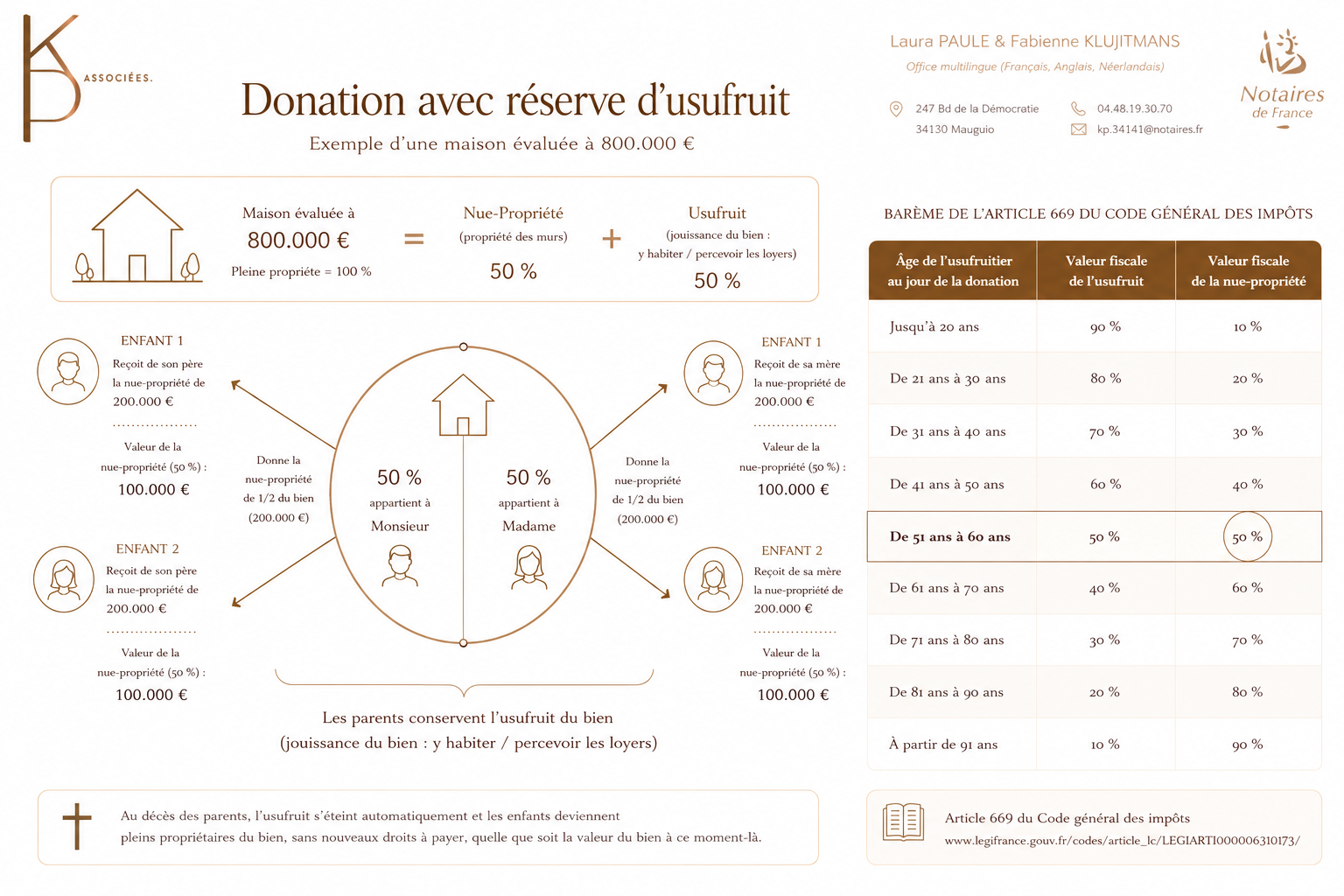
For tax purposes, its value is determined according to the age of the usufructuary based on the scale provided in Article 669 of the General Tax Code.
View the scale in Article 669 of the General Tax Code
Let us take a concrete example: two parents aged 58, each owning half of a house valued at €800,000, wish to transfer bare ownership to their two children.
At age 58, usufruct is valued for tax purposes at 50% of full ownership and bare ownership at 50%.
The house is therefore worth €800,000, but the bare ownership given is valued for tax purposes at only €400,000:
€800,000 × 50% = €400,000
With each parent giving bare ownership of their half to their two children, each child thus receives €100,000 from each parent.
Now, each parent can give each of their children up to €100,000 free of gift tax, with this allowance renewable every fifteen years (CGI, art. 779 and 784).
Provided the allowances have not already been used in the preceding fifteen years, bare ownership of a house worth €800,000 can thus, in our example, be transferred to the two children without any gift tax.
Upon Death, Full Ownership Is Reconstituted Without Additional Tax
The benefit of the gift with reserved usufruct does not end with the savings achieved on the day of the gift.
Upon the death of the usufructuary, their usufruct automatically terminates (C. civ., art. 617). The children, already bare owners, then become full owners of the property, without any new transfer of usufruct having to take place.
This reunion of usufruct with bare ownership occurs, in principle, without additional tax to pay (CGI, art. 1133).
Most importantly, it occurs regardless of the value the property has gained since the gift.
Thus, if our house, valued at €800,000 at the time of the gift, is worth €1,200,000 at the parents’ death, this increase in value does not result in inheritance tax on the reunion of usufruct with bare ownership.
The future appreciation of the property thus escapes, on this point, the estate transfer.
Benefit from the Allowances Again Fifteen Years Later
The benefit of advance planning also lies in the renewal of tax allowances.
Gifts made more than fifteen years ago are, under the conditions provided in Article 784 of the General Tax Code, no longer taken into account when calculating tax due on a new transfer.
By giving early enough, parents can therefore use their allowances today, then benefit from them again fifteen years later to transfer other assets or cash.
The age at which the transfer is initiated is thus decisive: an anticipated transfer allows the estate to be transferred progressively, rather than concentrating it at the time of succession.
Parents Can Pay the Costs and Gift Tax
Parents can also decide to pay the costs of the gift and, where applicable, the gift tax themselves.
Payment of tax by the donor is not considered for tax purposes as an additional gift (CGI, ann. IV, art. 171 ter).
The benefit is twofold: the children do not have to finance the tax due on what they receive themselves and the amounts used by the parents to pay the tax will no longer be in their estate at the time of their death.
Paying the cost of the gift can therefore itself contribute to advance estate planning.
Can the Gift Eliminate a Capital Gain?
When the gifted property is not the donor’s principal residence and has a significant latent capital gain, the gift may offer another benefit: eliminate all or part of the capital gain accumulated before the transfer.
Since the gift is not a sale for consideration, it does not, by itself, trigger taxation of the real estate capital gain.
In the event of a subsequent sale by the donee, the acquisition price used to calculate the capital gain is, in principle, the value used to determine the gift tax (CGI, art. 150 VB).
The capital gain accumulated between the initial acquisition of the property by the parents and its gift may thus no longer be included in the calculation of the subsequent capital gain.
Particular care must be taken, however, in the presence of a division of ownership, as the calculation of capital gain depends in particular on the rights sold and the conditions under which their sale or reunion occurs.
What If You Want to Sell the Property After the Gift?
Giving bare ownership does not necessarily mean immobilizing the property until the parents’ death.
However, this possibility must be anticipated when drafting the gift deed.
Once bare ownership has been transferred, the sale of full ownership generally requires the agreement of both the usufructuary and the bare owner. The allocation of the sale price must also be organized: Article 621 of the Civil Code provides for its division between usufruct and bare ownership according to the respective value of each of these rights, unless the parties agree to transfer the usufruct to the proceeds.
A well-drafted gift deed can therefore include charges and conditions on the gift and organize, in particular, the transfer of the division by subrogation to a new property acquired with the reinvestment of the sale proceeds.
These clauses preserve the economic benefit of the gift while maintaining the flexibility necessary to allow the family estate to evolve.
The gift with reserved usufruct is thus a particularly effective tool for planning the transfer of one’s estate without immediately relinquishing its enjoyment.
Its effectiveness depends, however, on the age of the donors, the composition of their estate, gifts already made, and their future plans: all elements that must be considered when preparing the deed.